
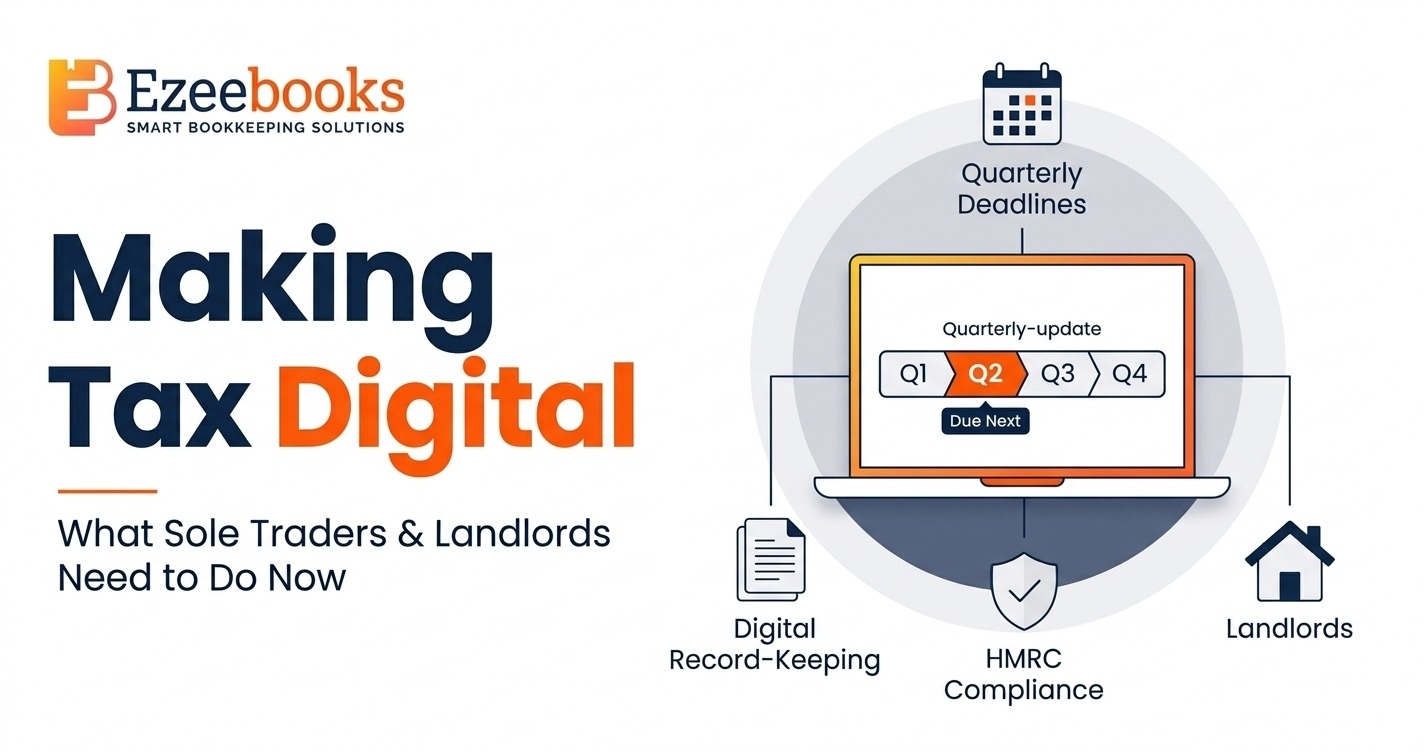
Making Tax Digital for Income Tax: What Sole Traders and Landlords Need to Do Now
If you’re a sole trader or landlord earning more than £50,000 a year, Making Tax Digital for Income Tax stopped being something to prepare for back in April. It’s live. The first quarterly update deadline has already been and gone, and from this month, HMRC has started signing up anyone who was required to join but hasn’t done it themselves.
This guide sets out exactly where things stand as of September 2026, what your next deadline is, and what to do if HMRC has (or hasn’t) contacted you.
What Making Tax Digital for Income Tax Actually Changed
Making Tax Digital for Income Tax (often shortened to MTD ITSA) replaced the old single annual Self Assessment process with quarterly digital reporting for people above the income threshold. Instead of one tax return in January summarising the whole year, affected sole traders and landlords now send HMRC four quarterly updates through MTD-compatible software, followed by a final year-end declaration that replaces the old SA100.
It’s worth being clear about what a quarterly update is not: it’s not a mini tax return, and it doesn’t calculate or collect any tax on its own. It’s a running summary of income and expenses for that quarter, submitted from digital records rather than typed into HMRC’s online portal by hand.
Who’s Affected, and the Phased Rollout
MTD for Income Tax applies if you’re registered for Self Assessment and your qualifying income — combined self-employment and property income, before expenses — was over the relevant threshold on your most recently filed tax return.
| Tax year used to test the threshold | Qualifying income threshold | MTD start date |
|---|---|---|
| 2024/25 return | Over £50,000 | 6 April 2026 |
| 2025/26 return | Over £30,000 | 6 April 2027 |
| 2026/27 return | Over £20,000 | 6 April 2028 |
Partnerships are not included in this rollout yet — that’s been deferred to no earlier than April 2027. If you’re a sole trader or a landlord (including a portfolio landlord holding property personally rather than through a limited company), the phasing above applies to you.
Where Things Actually Stand as of September 2026
This is the part that most existing guides written before April haven’t caught up with.
The first deadline has passed. The first quarterly update — covering income and expenses from 6 April to 5 July 2026 — was due by 7 August 2026. HMRC confirmed that more than 864,000 sole traders and landlords fell within scope for that first round.
HMRC is now auto-enrolling stragglers. GOV.UK’s official sign-up guidance was updated on 24 August 2026 to confirm that, from September 2026, HMRC will start signing up anyone who should have joined MTD for the 2026/27 tax year but hasn’t registered themselves. If HMRC signs you up this way, it uses only the information already on file from your last tax return — which may not reflect a business that’s changed address, added a second property, or stopped trading.
If HMRC Has Signed You Up Automatically
Check your details in the online service as soon as you’re notified, particularly your income sources and any changes since your last return. If something’s ceased or changed, you may need to update the service or contact HMRC directly — being auto-enrolled doesn’t mean the information HMRC holds is complete or current.
If You Haven’t Signed Up and Haven’t Heard Anything
There’s still time to register yourself, or ask your accountant to do it on your behalf, rather than waiting to be swept up automatically. Signing up yourself means you control what information goes in from the outset, rather than relying on whatever HMRC already has on record.
Your Remaining Deadlines for 2026/27
If you’re in the first mandatory wave (income over £50,000), here’s what’s left for this tax year:
| Period covered | Deadline |
|---|---|
| 6 April – 5 July 2026 (already due) | 7 August 2026 |
| 6 April – 5 October 2026 | 7 November 2026 |
| 6 April – 5 January 2027 | 7 February 2027 |
| 6 April – 5 April 2027 | 7 May 2027 |
| Final declaration for 2026/27 (via MTD software) | 31 January 2028 |
One detail that catches people out: your normal Self Assessment return for the 2025/26 tax year (the year before MTD started for you) is still due by the usual 31 January 2027 deadline, filed the traditional way. The two systems overlap for one transitional year before MTD-software filing fully takes over from 2026/27 onwards.
What Counts as Qualifying Income
Qualifying income is your gross turnover from self-employment and property combined — the figure before you deduct any expenses — based on the tax return you most recently filed. This trips people up in both directions:
- A sole trader with £55,000 turnover and £20,000 of expenses is still over the £50,000 threshold, even though taxable profit is only £35,000.
- A landlord with two properties adds the gross rental income from both together, not the net income after mortgage interest and letting agent fees.
If you have more than one qualifying source of income — for example, a self-employed trade and a rental property — each one has to be added and signed up separately as part of the same sign-up process.
Common Mistakes Worth Avoiding
A few patterns are showing up regularly as this first year plays out:
- Confusing net profit with qualifying income. As above — HMRC tests the threshold on gross turnover, not profit after costs.
- Assuming a spreadsheet alone is enough. MTD requires “digital links” between your records and your submission software — you can’t manually retype figures from a spreadsheet into separate MTD software. Data needs to flow through, via a bridging tool, CSV import, or direct software integration.
- Forgetting the transitional year overlap. Filing the 2025/26 Self Assessment return the old way, on top of the new quarterly updates for 2026/27, feels repetitive but both are genuinely required.
- Assuming a partnership is included. It isn’t, yet — don’t sign up a partnership return under this regime by mistake.
What Happens If You’re Late
HMRC has confirmed a specific easement for this first year: no penalty points will be applied for late quarterly updates during the 2026/27 tax year. That’s a genuine concession while everyone gets used to the new process.
It doesn’t extend to everything, though. Penalties still apply if:
- Your tax return is filed late (the usual Self Assessment late filing penalties).
- Your tax bill is paid after the due date.
From the following tax year onwards, a points-based penalty system applies to late quarterly submissions too — accumulate enough points and a £200 fixed penalty follows, alongside separate penalties for late payment.
Getting Ready, Practically
If you’re not yet set up, the practical steps are the same whether HMRC has already contacted you or not:
- Confirm whether you’re actually affected using your most recent tax return figures — gross, not net.
- Choose MTD-compatible software — a full accounting package, a simpler app, or a spreadsheet paired with bridging software.
- Sign up through GOV.UK (or have your agent do it), rather than waiting to be auto-enrolled.
- Set up digital links between wherever your records currently live and the software you’ll submit through.
- Diarise your remaining quarterly deadlines — particularly 7 November 2026, which is the next one due for anyone in the first wave.
How EzeeBooks Can Help
Sorting out digital record-keeping, choosing the right software, and hitting four new deadlines a year on top of your existing tax obligations is a reasonable thing to want help with — particularly if you’re also running a business or managing a rental portfolio. EzeeBooks provides fixed-fee bookkeeping services that are built to be MTD-ready from the outset, covering sole traders, limited companies, contractors and landlords, with a dedicated bookkeeper rather than a rotating support queue.
If you’re a landlord specifically, our Real Estate accounting service covers MTD registration and quarterly reporting alongside SPV accounts and Capital Gains Tax on property disposals. If you’re VAT-registered as well as being within MTD for Income Tax, our VAT Services team keeps both filing cycles reconciled against the same set of books, so nothing gets double-handled. And if you’re newly self-employed and trying to work out whether incorporating makes sense before MTD income thresholds catch up with you, our Start-Ups page covers that decision in more detail.
Frequently Asked Questions
Do I need to do five submissions a year under MTD for Income Tax?
No. You submit four quarterly updates plus one final declaration that replaces your old annual tax return — five submissions in total, not five tax returns.
I haven’t heard from HMRC — does that mean I’m not affected?
Not necessarily. HMRC’s auto sign-up process only started in September 2026 and is based on information already on file. If your qualifying income on your 2024/25 return was over £50,000, you’re required to comply whether or not you’ve been contacted.
What if my income drops below £50,000 next year?
The threshold is tested against your most recently filed return each year. If a later year’s income falls below the relevant threshold, you may no longer be required to continue — check GOV.UK’s eligibility guidance for your specific circumstances, as exemptions and thresholds are reviewed periodically.
Can I still use a spreadsheet?
Yes, provided it’s linked to MTD-compatible bridging software so figures pass through digitally rather than being retyped by hand into a separate submission tool.
What happens to my old Self Assessment return?
For the transitional year, you still file a normal Self Assessment return for the year before MTD started for you (2025/26, due 31 January 2027), alongside your new quarterly updates for 2026/27.
Will I be fined for missing the 7 November 2026 deadline?
No penalty points apply for late quarterly updates during the 2026/27 tax year specifically — this is a confirmed first-year easement. Penalties for late tax returns and late payment still apply as normal.
Does this affect limited companies?
No. MTD for Income Tax applies to individuals — sole traders and landlords — registered for Self Assessment. Limited companies file Corporation Tax returns and aren’t within this particular regime.
I have both a self-employed business and a rental property — do I need to sign up twice?
You sign up once, but each qualifying income source needs to be added and checked individually within the same sign-up service.
Making Tax Digital for Income Tax isn’t a future change to plan around any more — it’s a live obligation with a deadline landing in the next two months for anyone already in scope. Getting your records and software sorted now, rather than waiting to see if HMRC catches up with you, is the more comfortable way to handle it.
If you’d like help checking whether you’re affected, getting MTD-compatible software set up, or simply handing the whole thing to someone else, get in touch with EzeeBooks for a fixed-fee quote.